Our film 'Disturbance' uses many of the conventions of the horror films we researched, they gave us inspiration and insight into to some of the conventions we needed to go by like the way suspense is created through camera technique.
We used similar techniques in our film used by the actress Brittany Murphy who did a great job in portraying an innocent young woman, controlled and diminished mentally by her condition.

Here, you can see the character is hunched up and huddled, almost hugging herself for security. She is in a very defensive position to show how scared of the lack of control the mental illness brings with it.
She is clutching a doll, connoting the innocence she still possesses but due to her insanity she has lost. Because she has such little control over her life, by clutching the doll she instantly looks vulnerable and like a young child emphasising the lack of control again.

We tried to convey the same things by using similar body language as we thought it was very effective in 'Don't Say a Word'.
Here we have used the same huddled position to portray the insecurities she possesses, the loneliness and the urge to have someone to comfort her.
In this shot, the character is holding a torch. This anchors the need for comfort and security. It also highlights the fact that the only source of security is a torch rather than a person or anything slightly animate or sentimental.

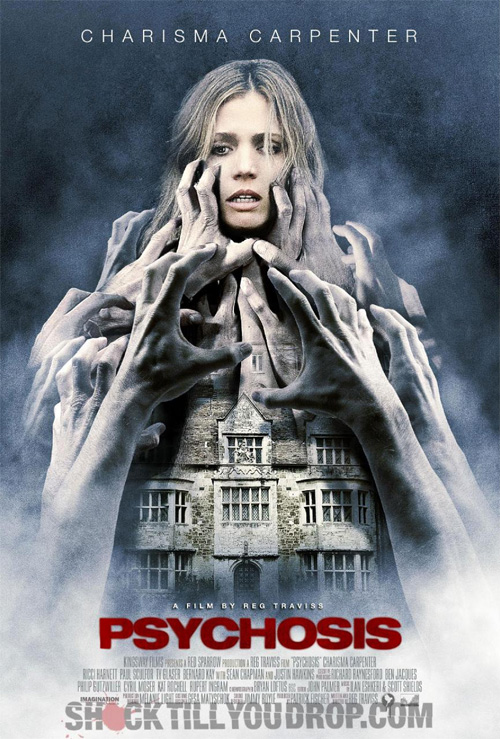
In this picture taken from one of the films we researched called 'Psychosis', the main character - again a young female, is seen on the computer doing some work. This activity is very common and instantly recognisable as we all do it and it is a normal, everyday thing to do. This scene features quite early on in the film, building up the tension and causing the audience to be subconsciously unprepared for the disturbing scenes that fit with the horror/thriller genre to kick in.

This screen shot taken from our film can be used as a comparison to the previous picture and what it connotes. Again, in this shot, the female is just returning home from work as the formal clothing anchors this. Immediately the audience associates this with a plain job working for a business of some kind and therefore a sense of order and normality to this character's life s established.
Although the shots are not directly comparable, they connote the same portrayal of a mundane, normal, average lifestyle to and both have the purpose of contrasting with the genre and what it entails later in the film inevitably to give the audience a shock, providing entertainment.
How does your media product represent particular social groups?
We wanted to have a very objective main character to keep a constant distance between her and the audience during the opening sequence. This way, we could keep the suspense and mystery high.
The fact that the character doesn't speak adds to keeping the distance. She very rarely shows her face - stopping the audience from seeing her emotions and expressions and consequentially, finding it hard to understand her and make judgements as easily. The only judgements that can be made would be from her appearance and the doctor's analysis that plays over the top of the film.
I think it was a wise choice for us to keep the main role mysterious because we knew we needed to build up the suspense and anticipation as much as we could to cope with the genre we chose. Before we even started any brainstorming for our film ideas we knew we had to be able to do so, because of previous films we'd already watched within the genre and how cleverly they achieved it. To fulfil such a task would be key in making the film as successful as possible.
By casting the main character as a young female, we felt it would connect well with our target audience. We aimed the film at a fairly young age group ranging anywhere from 15 and above. We chose a female role because, similar to 'Don't Say a Word' and 'Psychosis' the choice of a female lead was very successful in generating a creepy feel and a feeling of sympathy throughout. The fact that the character in our film is so young evokes a connection between the audience and the character.
None of the locations and sets we used during our film are particularly extreme, as i said before this was intentional because it juxtaposes with the themes and events.
During the first sequence the fact that the character is returning to her house dressed in work clothes which seem to insinuate quite a professional job. This shows the woman is quite dependent - appealing to a slighter more mature audience around 19 years and above; the age when one starts to think of a career and a home.

The second sequence involves the woman coming back from a run. This shows the character is healthy, likes to keep fit and look her best - appealing to young people who also participate in this activity, as it's unlikely many middle ages people would go on regular jogs.

In the third episode, the main character is situated in her room, which is related with young people. It's not often that 40 year olds spend their time hanging out in their room. So this appeals to the audience who do the same and may imagine having outside their window frequently.

What kind of media institute would distribute your media product and why?
When thinking about a distribution company, we thought of Metro-Goldwyn-Mayer (MGM), our film is a British film as we are the producers and the actors are British so to have the advantage of using an American distribution company would increase the reputation and therefore the overall audience interest dramatically.
MGM would be the perfect distribution company for us because they have dealt specifically with horror/thriller movies before with the film 'Asylum' (2008) and proved relatively successful. Female leads have also seen to be very popular as the films I've previously talked about show so this could attract them to distribute our film. Despite the fact it's only a small British film, horror/thriller films are becoming increasingly more popular particularly with young adults who are most likely to visit the cinema or buy DVDs so this film would be pretty successful with MGM on board!
Who would be the audience for your media product?
The audience for our film would be young adults as recent horror films have proved extremely popular with this age group. It could also be popular with more mature age groups as they can marvel in the mystery and challenging storyline our film has with it.
At first we decided to allocate a 12A film rating to attract a broader audience but then we thought about the themes and storyline which features murders etc. and raised that to a 15 rating. Although this reduces the audience range from the younger ages, older members would be more inclined to go and see the film due to more mature themes as opposed to a 12A which they might feel would feature very 'safe' themes and quite a drab storyline for what they expect with a good horror/thriller.
How did you attract/address your audience?
We gave out 20 questionnaires of the same type as shown above and received interesting results that encouraged us during film planning. We took the most common answer to use as pointers to go by.
One useful reply we obtained was from the question 'What is your favourite movie genre?' The most popular answer we received was thriller/horror and as a result, we decided to base our film on it, plus it's quite an adaptable genre to choose.
The intention to involve the audience and get them to constantly be asking themselves questions and having them revealed was premeditated as they acquire the feeling that they can help solve the mystery.
If we were to release a full film, we would use this poster to help with promotion because it's intriguing and draws attention to itself well, the exact intentions a promotional poster should do.
What have you learnt about technologies from the process of constructing this product?
Digital Video Camcorders:
We didn't get to a great start with the camcorder because we didn't have an HD tpye so we used a Canon MV930. This offered us a slightly weaker definition to the camera shots but it did not hinder our filming as we got straight on with it despite the lack of the top gear. The only drawback we faced was that the camera didn't pick up that much detail and it was very difficult to film in any sort of light but broad day light. We attempted to brighten the footage on Final Cut Express but we had no luck as it just didn't look right so we re-filmed the footage we needed in a brighter light/earlier time of day and edited that footage's brightness to still keep the eerie feel. Although the film's definition is not as professional as we would've liked it to be, we had to make do with what we had which was still a very capable camera indeed and having never really used a camcorder of that stature before, I persoanlly learnt a lot about how to use them well.
Apple Macs:
Being a strict PC user, at first I wasn't a fan of Macs at all, but that was before i had used them for over a long period of time. I still stand by my view that using a PC computer is definately easier but the facilities and applications that the Macs come with are so extensive and useful, I learnt how to use many programmes with great ease.
I'll admit there were some things that took me a while to get the hang of but towards the end, I really got the hang of utilising all the programmes we needed to use in order to edit and finalise our film.
I'm very pleased I've had the opportunity to use the Mac and its functions because I really enjoyed it and it was incredibly satisfying to see the footage turned into an edited, professional film that we have produced all by ourselves.
With the use of Final Cut Express and LiveType, which proved incredibly useful and simple to use, the film was able to take place and look skillful within merely a few days of editing.
Looking back at your preliminary task, what do you feel you have learnt in the progression from it to the full product?
It seems odd to look back at the preliminary task because we produced it such a long time ago and since then all of our skills in film production have advanced so much.
The main thing that producing the preliminary task taught me early on was how important keeping continuity really is. I didn't expect it to be as hard as it was when moving on to making the 2 minute film.
Using the Mac applications and editing the film was more fun and exciting than i expected as I had never come across anything as technological as that - being a first-time Mac user.